English
Piece of Mind
Open search engine
Search
Close search engine Clear Search
Products in the cart: 0. See details

Your cart is empty

Our puzzles are made in the European Union using eco-friendly, plastic-free materials and matte, dust-free finishes. We create puzzles not just as products, but as a calming experience that helps reduce stress, improve focus, and support digital detox in everyday life.

Why should seniors do jigsaw puzzles? Benefits for the mind and well-being

Putting together jigsaw puzzles is one of the simplest and most accessible ways to keep seniors' brains healthy. It combines cognitive training, relaxation, mood improvement and the opportunity to build relationships.

It proves that even seemingly small pieces can be used to create something bigger – peace of mind, satisfaction and a better quality of life.

Why should seniors do jigsaw puzzles? Benefits for the mind and well-being

Key phrases: puzzles for seniors, puzzle solving and memory, mental exercises for seniors, puzzles and brain health, hobbies for seniors

Ageing is a natural stage of life that does not have to mean giving up mental activity and pleasure. On the contrary, a properly chosen hobby can really support cognitive, emotional and social functioning. One of the simplest and most valuable activities is jigsaw puzzles for seniors.

Puzzles combine relaxation, mental training and a sense of purpose. It is an activity that can be easily adapted to one's abilities and needs – without pressure, competition or rush.

Puzzles as mental training

Putting together jigsaw puzzles is an effective mental exercise for seniors. This activity engages several areas of the brain simultaneously: memory, concentration, logical thinking and visual-spatial perception.

Regular puzzle solving:

  • supports short-term and long-term memory,
  • improves the ability to recognise patterns and relationships,
  • helps maintain concentration for longer periods of time.

Research shows that such cognitive stimulation can slow down the ageing process of the brain and support the prevention of neurodegenerative diseases such as dementia and Alzheimer's disease.

Better concentration and mindfulness

Puzzles require focus and patience. For many seniors, they are a natural form of calming down and practising mindfulness. Putting the pieces together allows you to take a break from your everyday worries and focus on the ‘here and now’.

It is a peaceful activity that helps to organise your thoughts, reduce tension and build a sense of inner peace.

The impact of jigsaw puzzles on emotional health

Doing jigsaw puzzles also has a positive impact on emotions. Each piece that fits into place gives a sense of small success, and the completed picture brings satisfaction and pride. This is particularly important during periods of loneliness, life changes or low mood.

Puzzles can become a daily ritual that gives structure to the day and a sense of purpose.

Manual dexterity and coordination

Although jigsaw puzzles are mainly associated with mental work, they also support the body. Grasping, turning and matching pieces:

  • improves hand and finger dexterity,
  • supports hand-eye coordination,
  • helps maintain precision of movement.

This is an important element in maintaining independence in everyday functioning.

Puzzles as a social activity

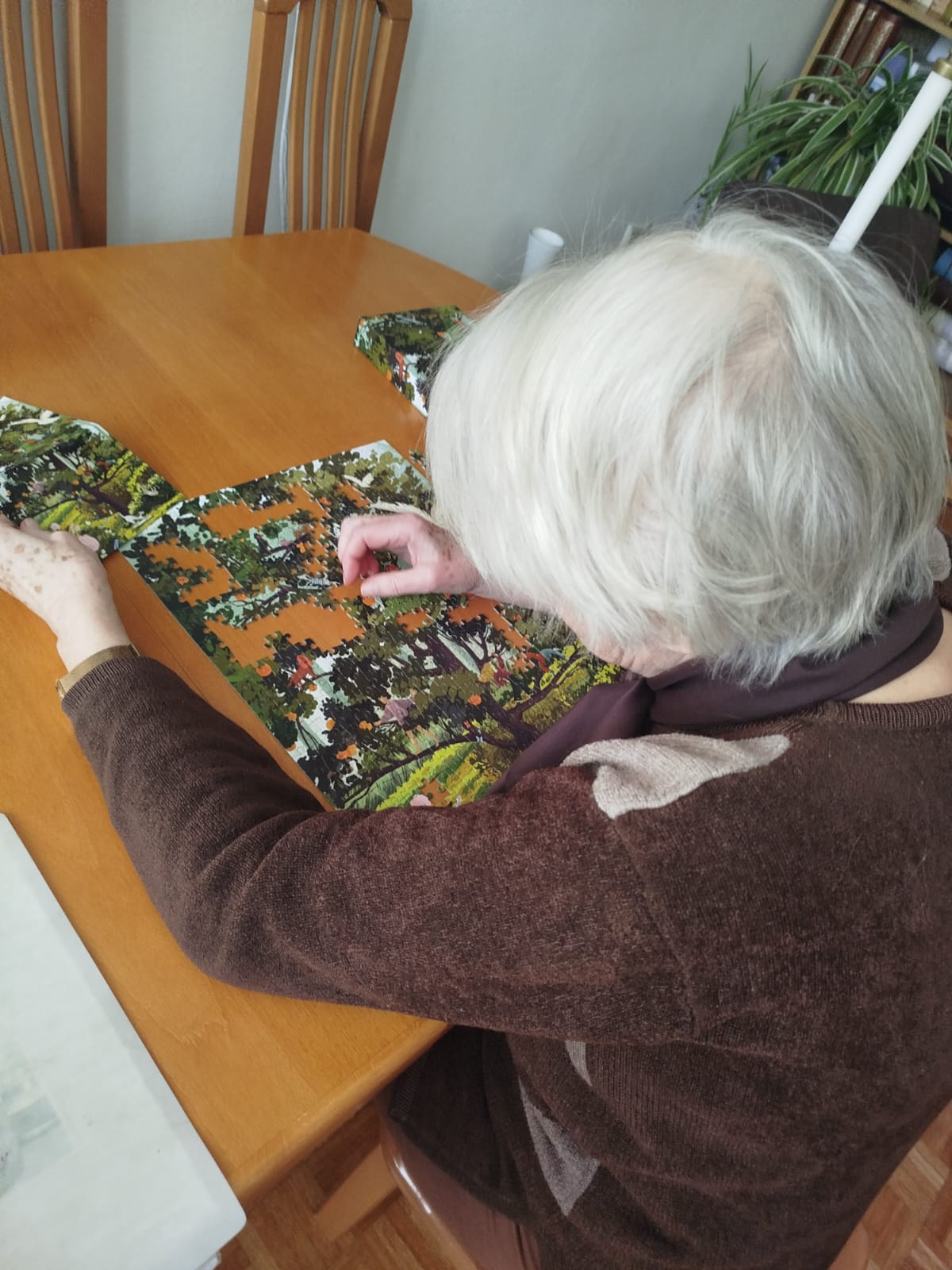
Puzzles do not have to be a solitary activity. Doing puzzles together with a partner, family or grandchildren encourages conversation and relationship building. Increasingly, puzzles are also appearing in senior clubs and day care centres as a form of integration.

It is an intergenerational activity that brings people together and does not exclude anyone.

How to choose a jigsaw puzzle for a seniors?

To make jigsaw puzzles enjoyable, it is worth paying attention to:

  • the right number of pieces,
  • a matte, anti-reflective surface,
  • calm, aesthetic illustrations.


recent articles

  • Puzzle therapy: why focusing on pieces calms the mind

    Life can feel overwhelming at times. Endless notifications, busy schedules, and constant streams of information leave many of us searching for ways to slow down and regain a sense of calm. While puzzles are often seen as a simple pastime, many people describe them as something more. For them, puzzling becomes a form of "puzzle therapy"—a quiet, focused activity that helps reduce mental clutter and create space for relaxation. But why does concentrating on hundreds of small pieces feel so calming?

    The answer lies in the way puzzles engage our attention, our hands, and our minds.

    Read more
  • Jigsaw Puzzles as a Form of Meditation

    When people think of meditation, they often imagine sitting quietly with closed eyes, focusing on the breath. While traditional meditation can be a powerful practice, it is not the only way to cultivate mindfulness and calm. For many people, meditation happens through movement, creativity, or focused attention. Gardening, knitting, painting, and even walking can create a meditative state. Jigsaw puzzles belong in this category too. Piece by piece, puzzles invite us to slow down, focus on the present moment, and temporarily step away from the noise of everyday life.

    Read more
  • What Is Slow Living and Why Does It Matter Today?

    In a world that often celebrates busyness, productivity, and constant connectivity, more people are searching for a different way of living. A way that values quality over quantity, presence over speed, and meaning over endless activity. This is the essence of slow living—a lifestyle that encourages us to be more intentional with our time, attention, and energy.

    But what does slow living actually mean, and why is it becoming increasingly relevant today?

    Read more
  • Why Analog Hobbies Are Making a Comeback

    A decade ago, it seemed that technology would replace many traditional hobbies. Smartphones, streaming platforms, and social media offered endless entertainment at our fingertips. Yet today, more people are returning to puzzles, books, drawing, knitting, and other offline activities. Why are analog hobbies becoming popular again?

    Read more
  • 7 Best relaxing hobbies after work

    After a busy workday, many people look for simple ways to unwind, reset their mind, and restore balance. It does not always require big lifestyle changes—often, small calming activities are enough to slow down and reconnect with yourself. Here are 7 relaxing hobbies that help you truly switch off after work.

    Read more
  • Why puzzles are a form of mindfulness?

    When people think about mindfulness, they often imagine meditation, breathing exercises, or yoga. Yet mindfulness can also be found in simple everyday activities. One of them is doing a jigsaw puzzle. No special equipment, no complicated techniques, and no pressure to perform. Just a table, a few quiet moments, and the next piece waiting to be found.

    Read more

    FAQ – Product Questions

    1. 🧩 Are the puzzles suitable for children?

    Our puzzles are primarily designed for adults and older teens due to their complexity, but older children may also enjoy them with supervision. Puzzle 1000 elementów będą natomiast bardziej wymagające i najlepiej sprawdzą się u dorosłych lub bardzo zaawansowanych młodszych użytkowników. Nasze produkty nie są odpowiednie dla dzieci w wieku poniżej 3 lat. Zawierają małe elementy, które mogą być połknięte.

    2. 🧩 What is the difference between 500 and 1000 piece puzzles?

    The main difference is difficulty and time required. 500-piece puzzles are quicker and easier to complete, while 1000-piece puzzles offer a longer, more immersive experience.

    3. 🧩 Do the puzzles produce dust?

    No, our puzzles are designed to be dust-free thanks to high-quality cutting and eco-friendly materials.

    4. 🧩 Do the puzzle pieces reflect light?

    No, the surface has a matte finish that reduces glare and makes the puzzle comfortable to work with under different lighting conditions.

    5. 🧩 What are the puzzles made of?

    Our puzzles are made from high-quality, eco-friendly cardboard produced in Europe. They are plastic-free and designed with sustainability in mind.

    6. 🧩 Are these puzzles a good gift idea?

    Yes, puzzles make a thoughtful and meaningful gift for anyone who values relaxation, mindfulness, and slow living experiences.

    7. 🧩 How long does it take to complete a puzzle?

    It depends on the size and experience level. A 500-piece puzzle may take a few hours, while a 1000-piece puzzle can take several sessions or days.

    8. 🧩 Can puzzles be assembled more than once?

    Yes, our puzzles are designed for multiple uses. With careful handling, they can be enjoyed many times.